


Blog courtesy of Beth Rogers, Bannockburn Civic Association and Environmental Committee member.
The Bannockburn community in Bethesda, established in the 1940s, has long had a strong sense of community. So much so, in fact, that in 1978, a book was self published on the community’s history and titled “Bannockburn: The Story of a Cooperative Community.” However, only in the last decade or so, has the community taken on an environmental mission and focus led by the Bannockburn Civic Association (BCA). The association strives to preserve and grow the neighborhood’s valuable green spaces and help the neighborhood become more resilient in the face of climate change.
More than 100 years old, Bannockburn Community Clubhouse is surrounded by about two dozen private homes. In the past, these homes received excessive runoff from the large building and parking lot on the club property and their backyards constantly flooded. The association’s former environmental chair helped secure Chesapeake Bay Trust grants to manage the flow of stormwater, create habitat for critters, and beautify the grounds. The former chair was also the driving force behind adding more than a dozen trees to these same grounds.

Bannockburn Community Club’s “Stream Walk” before and after the project was installed.
Currently, the BCA’s Environmental Committee, now helmed by Bannockburn residents Randall Ingate and Pamela Toole, has been working to educate the roughly 600 households that live within its borders about actions individuals can take to protect the environment. With no HOA to restrict what people do with their properties, the BCA has been looking to motivate residents to preserve green spaces as well as to adopt other environmentally-friendly practices.
This year the association’s Environmental Committee hosted a series of workshops, held at the Bannockburn Clubhouse. The first workshop, held in early March, featured Amanda Farber, an advocacy team member with Conservation Montgomery, and addressed Montgomery County’s continuing loss of tree canopy. All sorts of remedies were discussed, such as the need to proactively plant trees and County resources that could be accessed, such as the county’s free tree program, Tree Montgomery. The committee also discussed how to better care for existing trees and County laws that could be amended to better protect our tree canopy.

Amanda Farber, an advocacy team member with Conservation Montgomery, addresses Montgomery County’s continuing loss of tree canopy.
Other featured speakers were Ashley Triplett-Peltzman, a wildlife biologist with the Maryland Forest Service, who talked about forest health in the DMV; and Bannockburn residents Katy Levine and David Hecht, Montgomery Parks weed warriors who organize community work events, who talked about how invasive vines like porcelain berry and Japanese honeysuckle damage woodlands.
The second workshop was held at the end of June and featured a Bannockburn resident, Tim Boucher, a Nature Conservancy geographer, who has gradually remade his yard by removing invasive plants and replacing them with natives. Through an engaging series of photos he took, Boucher demonstrated how his yard is now a bird and wildlife sanctuary that supports biodiversity. His teachings were also in line with entomologist Doug Tallamy’s precepts on creating a linked national park through backyard habitats.

Photos courtesy of Tim Boucher.
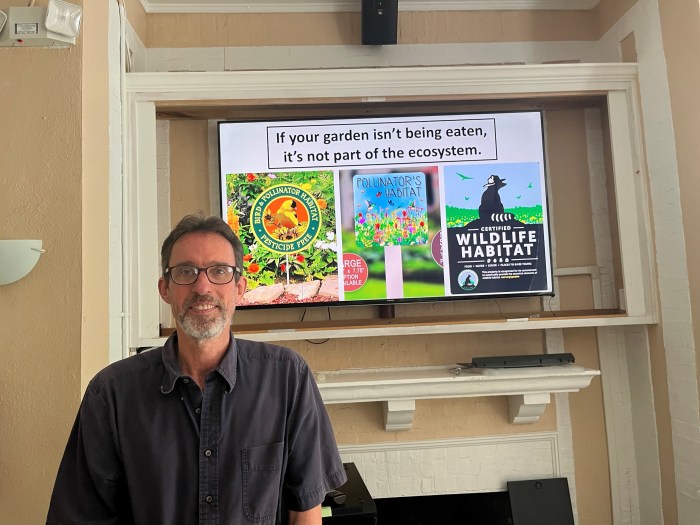
Tim Boucher, a Nature Conservancy geographer, presents on removing invasive plants and replacing them with natives in gardens.
Workshops have been paused until the fall, but this summer the BCA’s Environmental Committee is sponsoring an art competition with the assistance of Montgomery County Department of Environmental Protection, mostly aimed at engaging neighborhood youth, to paint select storm drains in the neighborhood. The goal of this project is to build awareness for storm drains and how they feed into the Potomac River and Chesapeake Bay, and how everything we do on land directly impacts the health of our water.
Learn more about the Bannockburn Civic Association’s community and green efforts at their website: https://bannockburncommunity.org/