
|
     |
|
|
|
|
|
Your guide to green living in Montgomery County, MD |
Peak hurricane season is underway and the National Oceanic and Atmospheric (NOAA) predicts an active 2024 season.
Now is a great time to reacquaint yourself with the programs Montgomery County Department of Environmental Protection (DEP) provides to help you be flood response ready.

The “Emergency Preparedness” Sponge is ready to help us get response ready!
The Flood Sensor Partnership is a cooperative effort among County agencies responsible for various aspects of public safety, storm event preparedness and response, and emergency management, along with the federal Department of Homeland Security (DHS).
Thirty-five next generation flood sensors are installed in areas of the County with a history of flooding, like low lying roads with stream crossings (Learn more about flood sensors here: Montgomery County Flood Sensors). The flood sensors automatically detect rising water levels and focus specifically on providing early warnings about high water levels or flooding. With this live time monitoring, DEP and our partners in the county can respond early and efficiently, distributing resources where they are needed most.
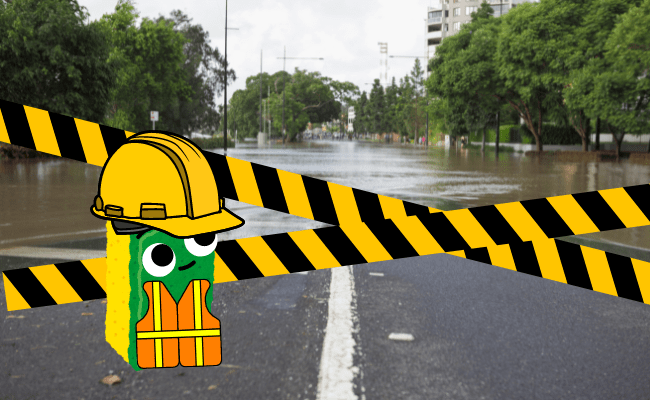
The “Emergency Preparedness” Sponge keeps Montgomery County safe by blocking off a flooded road.
County wide systems such as Alert Montgomery (sign up here: Alert Montgomery) help spread the word to citizens like you, giving your family the maximum time to respond to events.
Looking at flood sensor data over time also helps identify patterns of what causes the area to flood. Future maintenance or improvement projects can use this data to guide decisions on how to best manage flooding in the future.

The “Emergency Preparedness” Sponge prepares for future flooding emergencies by signing up for Alert Montgomery.
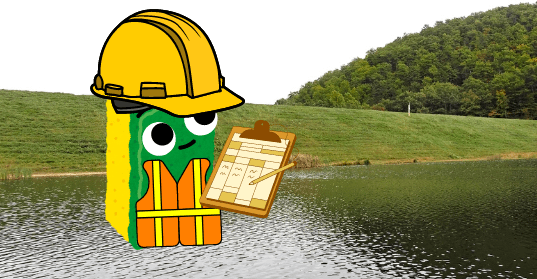
Montgomery County is subject to Maryland Department of the Environment (MDE) regulations regarding dam safety. There are over 30 high or significant hazard dams in Montgomery County, categorized based on how likely they are to flood. Montgomery County DEP is responsible for the dam safety programs at seven dams and two levees (a dam runs perpendicular to the flow of water to hold the water and create a temporary pond or lake, while a levee runs parallel to the flow of water, keeping it in the channel). The remaining high or significant hazard dams are privately owned and maintained.

Gudelsky Pond Dam in Rockville, MD.
Many of the significant and high hazard dams within the county are in stormwater facilities. DEP’s Stormwater Inspection and Maintenance Program includes routine operation and emergency response at the dams and levees the county is responsible for. During heavy rainfall events, you may see county staff out inspecting the dams and monitoring the water levels. These individuals serve an important role in the Emergency Action Plan (EAP), observing the condition of the dam in real time, they provide critical information to the engineers and officials who carry out the appropriate response.

The “Emergency Preparedness” Sponge assists with dam inspection and monitoring.
Sign up for Alert Montgomery text or email notifications at Alert Montgomery to stay in the know. Learn more about flooding on the Montgomery County Flooding Website.
|
|
© 2011 - 2026 My Green Montgomery |

