


On wet days in the Washington DC metropolitan area, most of the rainwater is unable to infiltrate into the ground. Instead, it becomes runoff as the water moves across impermeable surfaces (like roads, sidewalks, and rooftops). Runoff water is notorious for decreasing the quality of our local waterways, as it carries pollutants and sediment into storm drains. These storm drains then create fast-moving, concentrated flow into creeks that erode the banks. Ultimately, this fast-moving, pollutant-filled water ends up in the Chesapeake Bay.
With funding from the Montgomery County Department of Environmental Protection via the Chesapeake Bay Trust, Nature Forward developed a comprehensive stormwater management plan for its headquarters, Woodend Nature Sanctuary (in Chevy Chase, MD), in 2015. Since then, the organization has been systematically pursuing green infrastructure projects at the property to decrease the pollution of our local waterways and inspire visitors to adopt these best management practices themselves.
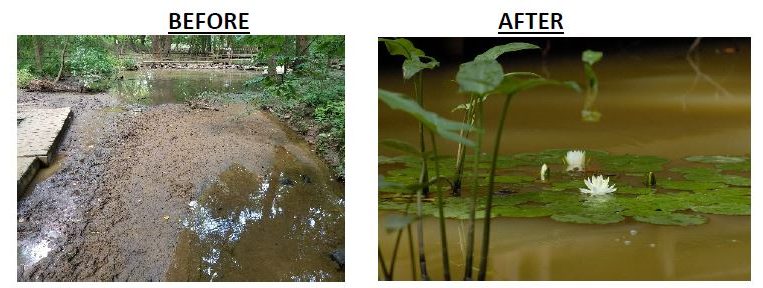
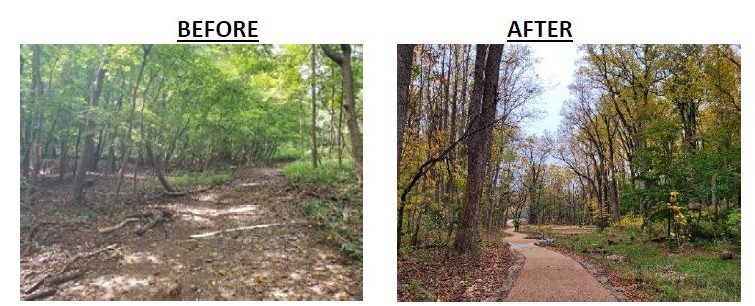
Before and after images of Woodend Nature Sanctuary, showcasing a walking path after invasive plants were removed and a pond after it was restored.
We are proud to say that Woodend now boasts a suite of projects that together treat 100% of the stormwater at the sanctuary. Several of those were completed with additional funding from the Montgomery County Department of Environmental Protection.
One way we approach the challenge of stormwater runoff at the Sanctuary is by limiting impermeable surfaces wherever possible. We do this by using permeable materials for some of our trails and parking areas. We have installed permeable paved areas throughout our property, including the west parking lot, the shop parking lot, and the walkway to the Learning Garden. By installing these permeable pavers, we’re allowing stormwater to permeate where it lands, reducing the creation of additional stormwater runoff.
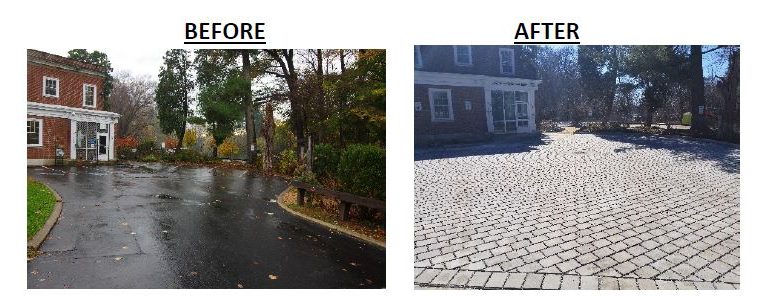
Before and after the installation of permeable pavers at Woodend Nature Sanctuary store parking lot.
To combat the runoff created by our preexisting impermeable surfaces, such as the house and our driveway, we use a suite of green infrastructure practices to help the water infiltrate as close as possible to where it fell. One of our most popular practices is our beautiful rain gardens.
Rain gardens are plantings optimized to infiltrate more than their “fair share” of rainwater. They can handle not only the rain that falls directly onto them but also an area of impermeable surface that drains to it. Along the driveway, our rain gardens receive water from the roadway via trench drains or curb cuts. Once the water has entered the rain garden, different structures work to help the water infiltrate. Many of our rain gardens include subdrains and gravel subbases to encourage infiltration. Others use sandy soil or a mix of subsoil decompaction and topography to provide similar results. In all cases, rain gardens also provide habitat through their native plantings.

Rain garden full of native plants at Nature Forward’s Woodend Sanctuary that collects and cleans water before it reaches Rock Creek.
In November of 2023, the installation of our largest rain garden allowed us to achieve our goal of treating 100% of stormwater that lands on impermeable surfaces at Woodend. The garden consists of two stepped pools and sits above our play-space. If the volume of stormwater exceeds what these two pools can hold, the overflow will go into a small conservation landscape where a series of small, planted berms will increase infiltration by slowing down the water as it flows down the slope. Inside the rain garden are many native plants, such as cardinal flower (Lobelia cardinalis), highbush blueberry (Vaccinium angustifolium), blue flag iris (Iris virginica), and dense blazing star (Liatris spicata). These species are known to enhance infiltration and provide habitat value for local wildlife.

Alongside the construction of this rain garden, we have produced an instructional video, in partnership with our communications department, in English (English Video) and Spanish (Spanish Video), on rain garden design and installation. These videos are used in our training for landscape professionals and are also made available to the public. Thank you to the Montgomery County Department of Environmental Protection for funding this and partnering with the Chesapeake Bay Trust to allow for these incredible improvements to be made at Woodend!