


 Guest blog post written by Alissa Cassidy, a writer who lives in the Atlanta area. She’s married with three sons, is a graduate student, and is an amateur photographer. When she’s not writing or studying, she enjoys working out, listening to music, and watching true crime stories.
In Montgomery County, our summers are hot and our winters can be bitter cold. These easy and practical tips can save energy — and keep utility costs down — year-round, especially in summer and winter.

Photo by George Milton
Fast-growing shade trees common in Maryland, like red maple, tulip poplar, and nuttall oak, can keep the temperature in your house down, reducing the load on your AC. Strategically place them near windows and on the sides of your house that receive the most direct sunlight.
Speaking of shade, placing taller bushes around your AC unit can keep it cool, too. Like any appliance, when it gets hot, it can be overworked, and you don’t want your AC to be overworked in our hot and humid summers.
A study by the Royal Horticultural Society showed that ivy is the best plant for insulating homes, both in summer and winter. Additionally, the vines reduced relative humidity, making hot summers feel less hot and cold winters feel less cold.
Be careful with ivy though as its roots can cause damage to the exterior of your home. Dense ivy also can hide issues with moisture or dampness or serve as a secluded haven for pests. Regularly check your ivy to ensure it’s doing good and not harming your home.
This may be obvious, but raising the temperature in your home, even just a few degrees, can help save money on your electricity bill. Experts say increasing the temperature 7-10º in the summer while you’re away from home can save you around 10 percent each year. Using a programmable thermostat makes this even easier because you can set it to warm up right after you leave the house and then lower again a few minutes before you get home.
Blinds, shades, curtains, and awnings serve more of a purpose than just looking nice. The right ones can keep out not only sunlight, but also lower the heat it emits – by about 77%!
Install awnings on west- and south-facing windows. Keep your curtains and blinds closed during the summer, especially on the windows where the light comes in directly. Be sure to install window treatments as close to the window and frame as possible to eliminate sun peeking through gaps.
Minimize energy loss by ensuring that all ducts are properly sealed or insulated. Also, be sure that furniture isn’t blocking any airflow from the registers and that those filters are regularly changed and the grilles are cleaned.

Photo by Thirdman
Just like in the summer, landscaping can lower energy bills in the winter, too. Creating windbreaks with evergreen trees is a highly effective way to protect your home from icy blasts when snowstorms hit.
There are nearly 20 different religious and cultural holidays celebrated in the winter season, and most of them include decorating with lights. By swapping out your old incandescent string lights with LED lights, you can save a lot of money on your electric bill. You may have to shell out more money at the get-go, but they cost much less in the long run. They also last longer, so the need to replace them year after year is also much less likely.
It’s a good thing people like to eat chili, casseroles, and stews in the winters. Cooking and baking heat up not just the food, but also the kitchen. If your house is fairly small, or you have a different thermostat for each floor, lower the temperature when you’re cooking a big meal and let the heat from the stove and oven do the work for a while.
Have you ever noticed how easily your hands get “burned” when you come in from the cold to wash your hands? Hot water feels even hotter when you’re cold. Use that to your advantage and lower the temperature on your hot water heater in the winter. It doesn’t take as much heat to feel hot when it’s already chilly.
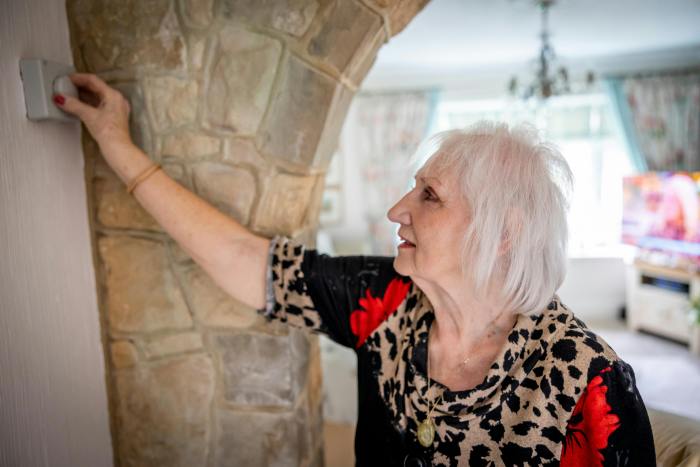
Photo by Centre for Ageing Better
In the summer, you probably use your outdoor space more often, but in the winter, it gets dark earlier. So in both cases, your outdoor lighting is used a lot. To reduce energy, use solar-powered lights to illuminate walkways, patios, decks, entrances, and even motion-detecting security lights.
No matter what time of year it is, ensuring your doors and windows are properly sealed is essential. Even in the spring and fall, when the weather is cool and you have your windows open, cracks in seals let bugs in. But if you want to keep your electricity bill down, then don’t let drafts from outside counteract the work your HVAC is doing.
In the winter, to circulate more warm air, set your fan to rotate clockwise at a slow speed. In the summer, flip it counter-clockwise and speed it up. This will push cool air down and create a breeze.
Reducing your energy output is not just better for your wallet; it helps the greater good, too. We could all benefit from being more efficient and aware of our carbon footprint. While we may not be able to make a huge difference, lowering the energy use in our own homes right here in Montgomery County is one small thing we can do to help. And that’s where change always begins –– at home.
And a bonus? Some repairs and upgrades will get you tax breaks, rebates, and discounts.