
|
     |
|
|
|
|
|
Your guide to green living in Montgomery County, MD |

Blog post was written by Clark Reed who lives in Rockville, works for the Environmental Protection Agency’s ENERGY STAR program, and has served on the city’s Environment Commission since 2011.
“Wait”, I said raising my hand, “you’re saying a net zero home is one that produces its own energy, is more comfortable than my current house, and transforms an annual expense into a net cash flow?” “That’s exactly what a ‘net zero energy’ home is”, replied our tour guide, “let’s go inside!”
So began our tour of the net zero energy (NZE) home on the campus of the National Institute of Standards and Technology in Gaithersburg. Built a decade ago, the home is both a laboratory and a house that is used to research the technologies needed to go ‘net zero’. Today, those technologies are common, widely found in the marketplace, and flying off the shelves due to the federal subsidies ($14K per family) offered under the Inflation Reduction Act (IRA).
Back in 2021 when we remodeled our home, we didn’t have access to those funds. Early adopters rarely do. Yet, we still found it to be an economical choice because the premium on a NZE home in our area was estimated to be approximately $17K more than a standard built-to-code home, according to the Rocky Mountain Institute. Since we were saving an estimated $2,000 in energy costs per year, the payback would be about 9-years — but when we factor in the cash flow generated by our roof from selling excess solar power, the break-even point shrunk to below 6 years. I can only imagine what the payback threshold is now for those fully accessing IRA funding.
Saving money is nice, but as much as we like that, we think the best reason to go net zero is for the comfort. We had lived in the house for 18 years prior to the remodel and knew every draft and cold spot the home had. And since our home didn’t have perimeter wall insulation, there were a lot! Back in 1951 when it was built, the solution was just to turn up the heat which only treats a symptom, not the cause. Over the years, our home became smaller to us because we consciously or subconsciously steered clear of certain rooms to avoid being uncomfortable. We don’t anymore. Now, every room is easy to be in, regardless of the season which is why comfort matters most. We experience that benefit every day.
NZE homes not only produce their own power, they’re all-electric. Without natural gas heating or cooking, there’s no need for carbon monoxide detectors. We no longer worry about carbon monoxide outside our son’s bedroom, nor do we make a u-turn with the car back to the house to double-check that the gas stove *really* was turned off! All-electric homes offer peace-of-mind because we’re not combusting a flammable gas on site.
We love to cook so it’s fair to ask, do we miss cooking with gas? Nope! Our induction stove uses magnets to heat the pots and pans. It’s quick and has the same (or better) precision with controlling the heat as with open flame. Cleanup truly is easier; we just wipe down the flat glass cooktop rather than the burners, grate, and cooktop of our old stove. Not all pans will work on an induction stove; they have to be magnetic for the technology to work. We lost a few of our pans when we made the switch, but it really wasn’t a big deal. Those who want to avoid retiring favorite pans can just get an electric resistance stove instead. There are lots of options.
After a few false starts, we hired John Spears of Sustainable Design Group because he had been building net zero homes for over two decades. We found him to be honest, affordable, transparent and extremely knowledgeable of the technical requirements of a deep energy remodel. We asked John to remodel our home so that it could be certified by the DOE’s Zero Energy Ready and the EPA’s ENERGY STAR programs. Homes built and certified to these standards use 40%-50% less energy than the typical new home, on average with no loss of comfort.
Energy efficient homes are an important foundation of being net zero because the energy used influences the amount of solar needed to meet the home’s needs. The less energy needed translates into a smaller, less costly solar array.
Surprisingly, we were the first of John’s clients to ask for a certified home even though home certifications have been available for over a decade. Is it because people don’t know they can ask for a certified home or that they don’t perceive the value of getting their home certified? We think it’s probably a little of both.
We wanted a guarantee that the money we were investing in energy efficiency was going to pay off. Certification gives that guarantee because the contractor follows proven federal guidelines based on building science. Certification requires the home be tested during critical phases of construction to ensure that technologies are properly installed. Your local city or county inspector won’t offer those services; they focus solely on safety and minimum code compliance. Certification offers the homeowner assurance that what they’re buying will actually deliver on the promise.
Some friendly advice: Many contractors eager for your business may try to convince you that they can build an ‘energy efficient’ house without ‘going through the hassle and expense’ of getting the home certified. But what are you actually buying from them – 5% more insulation? Efficient lighting? Less air leaks and drafts? It can all get confusing fast, especially for non-experts like the typical homeowner. What protects us as consumers are official guidelines, independent third parties, and certifications. A certified net zero home implies a minimum level of energy efficiency, more than adding just a bit more insulation or LED lighting.
If you’re interested in building or remodeling to a NZE standard, find a home builder who has experience in doing it by consulting the directory of the certification you want. In our case, those would be the program directories of Net Zero Energy Ready and ENERGY STAR. Had we done this in 2016, we would have been living in a remodeled home five years earlier.
Just because a home is built a certain way doesn’t mean it’s going to perform like you want it to. Equipment can be oversized, installed improperly, or not maintained. The precautions we took by getting our home certified, of following federal guidelines, and hiring a competent professional paid off. The home is indeed more comfortable, quiet, and healthy than the previous version. This section will cover the numbers for those who like data.
The house is not Net Zero, it’s Net Positive. Remember, ‘Net Zero’ is defined as producing equal amounts of energy as the home consumes over a 12-month period. When our solar was activated in October 2021, it took only 7 months for the solar array to produce as much as the home had consumed. It was Net Zero by May and Net Positive for the remaining 5 months.
Energy Production and Consumption for the year as of May 4, 2022.
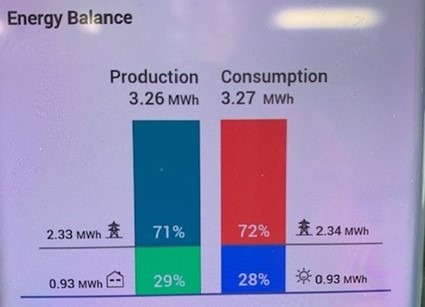
Became Net Zero on May 4 and Net Positive shortly thereafter as daylight continued to lengthen.
In 2022, the arrays produced 35.7% more energy than the home consumed over the year — 11.4 MWh of production versus 8.4 MWh of consumption. In 2023, the arrays produced 37.5% more, 11 MWh of production compared to 8 MWh of consumption.
In terms of efficiency, the average home in Maryland uses 12.4 MWh of electricity over a year. For the past two years, this home used 33% – 37% less energy than the typical household. The slightly lower energy performance could be due to having just experienced the hottest year on record. Additional data will hopefully make that more clear in the months ahead.
After twenty years of saving for the remodel, drafting and revising the plans, and being inspired by the students competing in DOE’s Solar Decathlon, it’s extremely gratifying to see the end result of this journey. We believe the home is the first certified NZE home in Montgomery County and the 11th in Maryland, according to Team Zero, an organization that tracks certified homes under several labels. (Note: The NIST home mentioned earlier is neither certified nor occupied.)
Not everyone can go net zero all at once, nor do they have to. A slower more prescriptive approach is certainly an option, too. For that, I’d recommend following the six energy efficiency improvements promoted by the EPA’s ENERGY STAR Home Upgrade. All work together to give significant savings.
Whether your journey to net zero is fast or slow, the end result will be good for your bottom line, your family’s health, and our environment. Good luck!
Comments are closed.
|
|
© 2011 - 2025 My Green Montgomery |


Will future tours be available??
We often open the home during the National Solar Homes Tour in October. Check their site in Sept to see if it’s on the tour.
What features make Montgomery County’s First Certified Net Zero Energy Home stand out in terms of energy efficiency? Greeting : Telkom University
The following features make the home energy efficient per U.S. EPA ENERGY STAR certification standards: R26 insulation around perimeter (R19 code), R52 insulation roof (R49 code); ENERGY STAR certified double-pane windows, air sealing (final test was below 3 ACH@50p); LED lighting, ENERGY STAR appliances; mini-split heat pumps; and LED lighting.
Congratulations, Clark! You are walking the walk, as people say and benefitting in many ways as well. A lot to unpack here; a deeper conversation must be had in the near future!
I installed a geothermal unit in December of 2013, 10.2 kW solar system in 2014 and then added another 2.1 kW to the system in 2015 (total 12.3 kW system). I have had HERS score of -11 in 2015 (or early 2016), so I have demonstrated that I’ve been better than net zero for about nine years. Currently, any excess electricity I generate goes to help charging my plugin hybrid. Combined, my systems turn my home into a money maker.
You certainly have – congratulations Tom! Thanks for sharing your story.
That is all retrofits to a house built in 1972 or 73. Obviously it is better (and cheaper) to incorporate all of that when the house is being designed and built where one can position the house and specify the pitch of the roof to maximize energy production from solar, and identify/design zones for heating and cooling, etc. But it just shows that beyond adding insulation, a home owner can make improvements that generate revenue for the home owner if they only thought longer term (even if they don’t stay in the house for 20 years they’d get a better price if they sold a house that had little to no energy bills). Unfortunately too many people don’t look beyond the initial costs. Since my geothermal replaced oil heat, the system paid for itself in about seven years. Worst case for solar was a payback of almost 20 years in the SRECs were not worth anything, but so far I’ve earned over $5,000 in SREC payments in less than 10 years.