
|
     |
|
|
|
|
|
Your guide to green living in Montgomery County, MD |

This blog post was written by Gerald Sharp, resident of Montgomery County for his neighborhood newsletter.
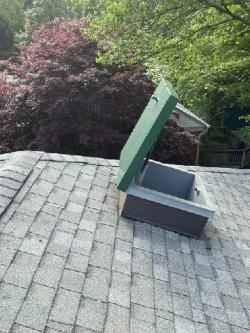
Figure 1: Door from attic to roof
When I added a floor to my house on Edgefield Road about 10 years ago, I had the electrician run a tube from the attic to the electric panel in the basement, thinking that someday I’d want to put solar panels on the roof. And I also had a door installed on the roof so I could get to it from the attic without using a long ladder. I even took a night class at Montgomery College on photovoltaics where we were actually taught how to install the panels, but still I delayed having a system installed. Last year I asked myself what was I waiting for? Did I think we’d have better government subsidies to pay for solar panels? Were prices of panels going to come down? Was PEPCO going to be reducing what they charged for power? With the answers to all these questions being “no”, I made the leap in 2023 to tapping the free electricity coming from the sun. And then I also ended up buying an electric car that would be powered by sunshine.
The deciding factor for me was last August when I learned about the Capital Area Solar Switch program where they get bids from local solar panel companies and give home owners in Montgomery County (and DC and Northern VA) access to the lowest bidder. This seemed like such a smart idea, and it also took the decision of having to figure out which company to hire out of my hands. I figured the program would pick a company not only with the best prices, but one that they had vetted that was likely to do a good job.
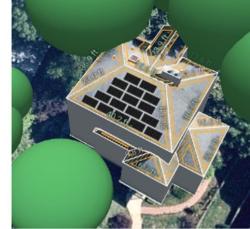
Figure 2: Plan for solar panels on roof
Last summer Lumina Solar in Baltimore was one of the contract companies, and, according to the Solar Switch website, about 2,000 houses in our three-jurisdiction area signed up for the program. Lumina told me their price was a 20% discount from the usual cost plus there was a 30% federal tax credit and a $1000 state rebate from Maryland. I paid the Solar Switch fee of $150 to find out how many panels could be installed on my house and what the system would cost. The program linked me with Charlie Keyser, the representative for Lumina. He asked for a copy of my last PEPCO bill, and a couple of days later we met by video phone call to discuss the system that could be installed. Charlie pulled pictures of my house off of the internet and showed me his analysis, including these figures below showing where the panels would go on my roof with those big green blobs representing the trees surrounding my house. Surprisingly, because of my trees, the roof design and the roof’s low pitch, the best location for the panels was on the north side. Other houses with fewer trees and roof designs with better sun exposure would be better candidates. Charlie’s report also included the amortization calculation below which shows the total cost of my 17-panel system and the reductions in the system’s cost coming from the federal tax credit and Maryland rebate.
Because of the Solar Switch program the total cost of my 17-panel system was $19,658, a 20% reduction from Lumina’s usual charges. This price was furthered reduced by the federal and Maryland subsidies down to $12,761, about half the usual cost. This system would provide 6,885 kilowatt hours of power per year. Taking into account future costs of electricity, the amount of power provided by my system and income from SRECs (short for Solar Renewable Energy Credits), the payback time for my system (the time needed for cost savings from reduced electricity bills to pay for my costs installing solar power) was just over six years. Over the 30-year lifetime of the system, the cost saving from installing the panels was estimated to be $126,238.

Figure 3: Amortization table on left showing production of system, anticipated electricity costs & savings, SREC income, total cash savings, and estimated payback time (cost of system minus cost savings). System Specs Table on right shows total cost of system and actual cost taking into account government subsidies
SRECs and future electricity costs both need to be taken into account in figuring cost savings from installing solar power. PEPCO and other power companies in each state are required to provide a certain amount of electricity from solar and other renewables, and if they don’t produce enough themselves, then they can buy SREC credits from customers with solar panels. The current price in Maryland is about $55 per 1000 kWh SREC, so my 6,885 system would pay me about seven times $55 or about $375 this year. DC, which has fewer customers with solar panels, currently pays about $442 per 1000 kWh, so my system if installed in DC would give me about $3000 this year. SRECs aren’t available in every state, but where they are, they’re a valuable source of extra income in addition to your monthly savings on your utility bill. The SRECs are in that third column from the right in my amortization table in Figure 3. Charlie figured that there would be enough solar power generated in Maryland in the future that SRECs would only be available for eight years, with SREC income declining each year until then.
The column on the right side of the table shows the estimated time to pay for the system from reductions in my PEPCO bill; for my house this time was just over six years. I asked Charlie how he calculated the future costs of power (combined cost of power and its distribution), which in the amortization table in Figure 3, you can see starts out at $0.179 per kWh in Year 1 and increases to $1.668 kWh in Year 30. Thus, he estimates the power bill for my house 30 years from now, when I’m not likely to be living in it, would be 6,885 times $1.668 per year or about $957/month. Charges for electricity are two-part. There is the charge for production of electricity from a variety of providers and there is the distribution charge that utilities charge to provide you with electricity. I asked Charlie how he could know the future cost of electricity. He said economists think that the combined price of electricity and its distribution will increase from 4% to 8% per year, and he used the higher estimate of 8% in his calculations. It’s hard to know the future costs of generating electricity, but 8% seems high. Costs will go up as the cost of oil and natural gas needed to fuel power plants goes up. It might go down if more power is generated by wind turbines and electric panel farms, but there are costs to installing these that need to be recovered. These are some of the current average generating costs of electricity in Maryland and other states from this website: Maryland (13.9 cents/kWh); Connecticut (21.6 cents/kWh); Massachusetts (18.6 cents/kWh); New York (19.3 cents/kWh). Hawaii, which has to import fossil fuel for its power plants, has the country’s highest rate (32.8 cents/kWh), and solar panels are going gang busters there—even being installed on condos.

Figure 4: New electrical boxes for the solar power system with cutoff switch
Charlie said that his 8% estimate for the annual increase in power costs might actually be a conservative estimate—that PEPCO and other power companies are going to have to expand the grid as people buy more electric cars and the amount of electricity used increases (for example as the population grows and more housing units are built.) This distribution charge is based on the amount of electricity we use, so although PEPCO’s cost to supply us with electricity doesn’t change when we install solar panels, their income decreases because we use less of their electricity, and, thus, this is another reason they need to increase their distribution charges. Charlie said these increased charges are already happening in New England, and they are also happening in Maryland. Power companies are regulated by each state and DC, and they are allowed to pass on their increased costs of distributing electricity to their customers by raising their rates. The Maryland Office of the People’s Council published a report on PEPCO’s application to Maryland’s Public Service Commission (PSC) to increase its distribution rates. Each time a regulated utility company wants to increase the price it charges for distributing electricity or natural gas, the company files an application with the PSC. In May 2023, Pepco filed an application for a multi-year rate plan (MRP) requesting that the PSC approve a series of rate increases over three years. This MRP is PEPCO’s second; the PSC approved its first MRP in 2021. According to this report, PEPCO has asked permission to increase its price for distribution from $0.039/ kWh in 2023 to $0.055/kWh in 2024 (43% increase) and up to $0.069/kWh in 2027 (77% increase from 2023 to 2027). Thus, this year the total average cost of electricity for PEPCO customers (assuming the increase is approved) will be $0.139/kWh plus $0.055/kWh=$0.194/kWh. PEPCO’s application to the PSC states that the “total bill” cost increase from raising their distribution charges will be 5.0% in year one. Although it’s impossible to exactly predict our future power bills, it is clear that as more people install solar collectors reducing utility income, as the grid is expanded to provide more electricity, and as inflation increases material and labor costs, our electric bills are going to be increasing. The escalation rate of 8% for future electricity costs that my Lumina rep used seems high, though, and 6% seems more on target. Changing the escalation rate in the calculation would increase the payback time.
After reviewing the contract and cost estimates, I decided to go ahead with the installation. One decision I had to make was whether or not to have a house battery, which would add substantially to the cost and increase the payback time. Maryland requires that power companies do net metering, which means that the utility must credit you for putting electricity into the grid at the same rate that they charge you. Not all states require this, with the electric utilities arguing that they shouldn’t have to pay you the retail price for electricity your panels generate. With net metering (thanks, Maryland), the grid acts as your battery, letting you put extra electricity into the grid and allowing you to take it back out when you need it. One disadvantage of this is that if there is a power outage, you cannot use your solar collectors as a backup system, because PEPCO will cut off your system to keep it from electrocuting its linemen. I decided not to install a house battery, figuring that with our infrequent power outages, it wasn’t worth the added expense. I did buy a small gas generator to get me through a future power outage if we have one.
I paid my 30% deposit of $5898 in August 2023. Lumina would have allowed me to finance the cost, but I paid cash. Both the federal and Maryland governments require us to pay the full charges and get the discounts later. This wasn’t too bad for me, since I received the 30% federal tax credit when I filed my taxes a few months later, but I didn’t receive the Maryland check for $1000 until the end of April. (Note to Maryland legislators: why not just pay the installing company the $1000 and let them take it off the cost of the system?) Lumina was good about scheduling the installation and they handled all the permits needed and the application for the Maryland $1000 rebate. In October, Tesla announced an update of their popular Model 3 for 2024 and reduced the price of their 2023 Model 3’s with government subsidies down to the cost of a Toyota Camry. I had had the same car for 20 years and with its odometer now recording 208,000 miles, I decided it was time for a new car. Luckily, I had planned for the future and had ordered a 240-volt charging outlet as part of my installation. Maryland offers a rebate of half the cost of a charger installation up to $700, which for me would be $600 of the $1200 charge. Most other states just pay $250, so Maryland is more generous, except that the state has not allocated enough funds to cover these rebates, and all outlet rebates are currently on hold. I haven’t received it yet and may never get it. (Note to our legislators: why not just pay $250 to the company installing the outlets, keep the costs within the state budget, and make this process a lot easier?)

Figure 5. Panel team installing panels on my roof

Figure 6: Screenshot from Enlighten app on my iPhone that tracks electricity coming from panels, being used by house, and being put into the grid. It also generates monthly reports and there is a live view option
The Lumina teams arrived at my house early on November 6, 2023, to install the solar panel system. I say “teams” because there was a team of panel installers and a team of electricians to install the wiring and various new electric boxes. The electricians were very happy that I had installed a door to the roof and that tube for their wires extending from the attic to my electric panel in the basement. Unfortunately, I hadn’t been as foresighted and had not similarly installed a tube for the outlet, and the pipe for those wires had to go over my roof and down the side of my house. But the installers were careful and disguised it to make it less obvious. The teams worked quickly and by late afternoon, the system was in place.
I paid my second installment of $11,795 after the installation and my final payment of $1966 after the system passed the Montgomery County inspection and an inspection by PEPCO, and I turned it on. Figure 7 is a screen shot from an app on my iPhone named Enlighten that tracks electricity use each day in my house, what is coming in from the collectors, and what is being fed back into the grid. There is a live view function and monthly reports. Figure 8 below shows the monthly report from the app for March 2024 showing that my solar panels supplied 75% of my power use then. I’m expecting a higher percentage as days get longer this summer.
The system has worked flawlessly from when I turned it on. The system was designed before I had my electric car, and, thus, my yearly use of electricity is greater now than it was last year, justifying the installation of more panels. With the solar panel system in place now, it is fairly easy to add more panels, and I will probably add more. The 240-volt outlet fully charges my car in about 5 hours, and it’s easy to back it into the driveway and plug it in after trips. I’ve only used the Tesla super chargers a couple of times while on trips outside Maryland, and this has worked well. The car provides a map of available chargers with their prices, and you can set the navigation system to take you there. The car warms up the batteries on the way to speed up the charging time.
Lumina Solar has offered to provide a free estimate of what a solar panel system would look like on your house with the costs taking into the subsidies and that amortization schedule that they did for me. They just need to see a power bill. If you’re interested, email Charlie Keyser at ckeyser@luminasolar.com.
Get the free assessment from Lumina or wait for the next Capital Area Solar Switch program to start, pay their $150 fee, and compare the two assessments. The estimated future cost of power is a key determinant of payback time, so make sure both assessments use the same escalation percentage (I suggest 6%) for predicted increases in electricity costs.
|
|
© 2011 - 2026 My Green Montgomery |

