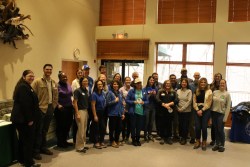
On Friday, January 31, the Izaak Walton League of America along with the Interstate Commission on the Potomac River Basin and Montgomery County Department of Environmental Protection hosted the Winter Road Salt Awareness Week Open House at the Izaak Walton League of America’s National Office Headquarters in Gaithersburg, Maryland.
The in-person event was part of the Winter Salt Awareness Week campaign designed to raise awareness around road salt pollution and reduction solutions. The week was filled with livestream, webinars and concluded with a salt monitoring event at the Izaak Walton League of America’s headquarters.
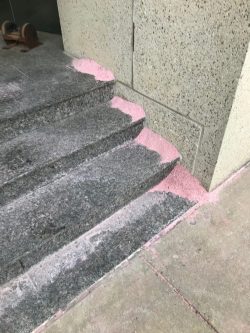 So what’s the problem? Why a winter salt awareness week?
 Each year in the United States, between 20-30 million tons of road salt is applied on sidewalks, roadways and parking lots depending on the winter weather conditions. Although road salt keeps us safe during icy winter conditions, using more salt than is needed comes at an expensive price to our waterways, infrastructure and our drinking water. After being applied, road salt runs off the roads and becomes a permanent pollutant in our waterways. Only one teaspoon of road salt permanently pollutes five gallons of water.
An informed public can support the adoption of best practices in snow and ice control and advocate for the protection of freshwater resources.
Representatives from local partner organizations were present with informational tables and displays about how their organization is working to promote education around smart salting practices, why we should care, and the impacts road salt has on wildlife, drinking water, and infrastructure.
 The Speakers and Topics
Although a rainy day, the League’s Salt Watch Coordinator, Abby Hileman, took att

endees out twice during the event to monitor the Muddy Branch—a local waterway that drains into the Potomac River—for road salt pollution. During thaw or rain events in the winter, rain and ice/snow melt often washes salt into local waterways where monitors often see spikes in chloride levels quite often showing conditions that are toxic to freshwater aquatic life (levels set by the US EPA).
The week kicked off with livestream webinars from speakers across the United States describing the problems of road salt pollution, the solutions, and ending the week with monitoring local waterways for road salt pollution. About 900 individuals were registered for the weekly livestreams and some of the recorded livestreams have had over 750 views on Youtube. Visit the Winter Salt Week website to view livestream recordings.
Abby Hileman, the Izaak Walton League’s Salt Watch Coordinator, spoke about the background of the road salt pollution issue and one way the League is working to counteract the problem, through Salt Watch. Through Salt Watch, the League supplies free test kits to anyone interested in monitoring water for road salt pollution. Through this program, Salt Watch is mobilizing community scientists to monitor local waterways for road salt pollution and advocate for smarter salting practices.
Dr. Jess Hua highlighted how “sublethal” concentrations of salt can still be harmful to wildlife and how other environmental factors like predators and water chemistry can alter the effects of salt on wildlife.
Individual livestreams from publics works staff were presented with representatives from Maine, Maryland, Michigan, Minnesota, New Jersey, New Hampshire, Virginia and Wisconsin speaking. Presenters discussed recent successes and challenges in transitioning to newer technologies and adopting policy changes.
Ted Diers (New Hampshire Department of Environmental Services), Cara Hardesty (Ohio Environmental Protection Agency), and Bryan Gruidl (City of Bloomington, Minnesota) spoke about policy solutions that have been enacted to address various facets of the salt pollution problem.
16 events in 7 states (Maryland, Michigan, Minnesota, Missouri, New Jersey, Pennsylvania, and Wisconsin) were held dedicated to water monitoring using Salt Watch kits on Local Salt Monitoring Day (Jan. 31).
The “Smart Salting for Community Leaders” free online workshop was held to help community leaders understand the impacts of chloride on infrastructure and water resources and provided resources and specific action steps to make policy changes in their communities to reduce salt pollution.
The first winter salt awareness week observed in Maryland was a success, thanks to many environmental conscience organizations and individuals.